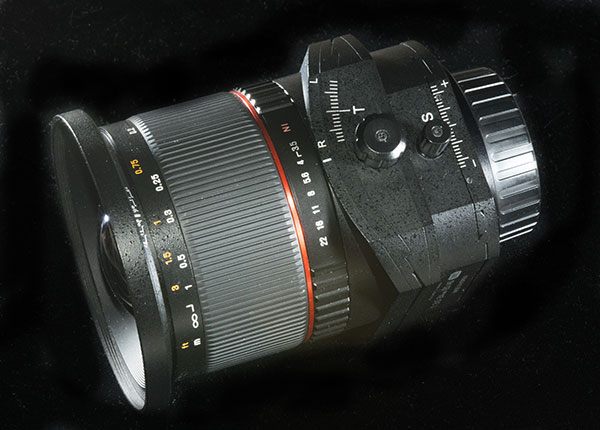
 Een merkwaardige groothoeklens is de Samyang 24mm. De Samyang is het goedkopere broertje van de Nikon ts of Canon ts lens. De Samyang is alleen een stuk goedkoper dan de Nikon of Canon, en doet niet veel onder qua kwaliteit. Het is een zogenaamde tilt-shift (ts) lens. Dit betekent dat de lens kan kantelen (tilt) en links-rechts kan schuiven (shift). Door het kantelen kun je je scherpstelvlak verleggen, waardoor je een veel grotere scherptediepte kan creëren. Het shiften is handig om bijvoorbeeld vertekening (buigende bomen of gebouwen) tegen te gaan en het is ook een makkelijke manier om panorama’s te maken (door middel van sticthen). Deze lens kocht ik in 2013 en sindsdien heb ik er een soort haat-liefde verhouding. De lens is oerdegelijk gemaakt en ragscherp, maar het maken van een goede opname is een heel gedoe. Je moet handmatig scherpstellen (bij voorkeur met live view) op een punt voorin en dan op een punt achterin. Daar bereik je de optimale scherpte door te gaan kantelen. Dat gaat met erg kleine draaiknoppen, en dat is niet heel makkelijk (zeker niet bij temperaturen rond het vriespunt). Dit ritueel herhaal je een aantal keer, totdat je alles perfect scherpt hebt. Als dat dan allemaal gelukt is, dan zal de foto niet teleurstellen. Maar goed, heel vaak vind ik het simpelweg teveel gedoe, dus ik pas het alleen toe als het echt nodig is (als ik bijvoorbeeld heel veel scherptediepte wil creëren).
Pluspunten:
– Uitstekende kwaliteit en scherpte
– filtermaat 77mm (handig voor gebruik met filters)
– Ja! Scherptediepte!
– stevige lens
– handig voor het maken van panorama’s met behulp van stitchting.
– geen tonvorming
Minpunten:
– filtermaat 82mm (Lee filters 77mm zijn wel bruikbaar met een speciale ring)
– redelijk zwaar
– poe, poe, wat een gedoe voordat je een foto kan maken.
– manuel focus
– eigenlijk alleen te gebruiken vanaf statief.
Hier enkele voorbeelden gemaakt met de Samyang 24mm f/3.5 Tilt-Shift Lens:

 [:en]A curious lens is the Samyang 24mm. The Samyang is cheaper brother of the Nikon or Canon ts ts lens. The Samyang’s just a lot cheaper than the Nikon or Canon, and of also good quality. It is a so-called tilt-shift (ts) lens. This means that the lens may tilt (tilt), and can slide left-right (shift). By tilting, you can shift your focus level, allowing you to create a much larger field. The shift is useful for example prevent bending trees or buildings and it’s also an easy way to create panoramas (through sticthen). This lens I bought in 2013 and since then I have a sort of love-hate relationship with it. The lens is made very solid and tack sharp, but making a good image is quite a hassle. You have to focus manually (preferably with live view) at a point in front of the picture and then at one point in the back. This is done by tilting the lens. The lens has very small knobs, and that’s not easy (especially at temperatures around the freezing point). You have to repeat this ritual for several times until you have tightened everything perfectly. If you have gone through this succesfully, the result will not disappoint you. But, quite often I find it simply too much hassle, so I pass it only if it is really necessary (for example, if I want to create a lot of depth).
Pros:
– Excellent quality and sharpness
– Filter Size 77mm (handy for use with filters)
– Yes! Depth of Field!
– Sturdy lens
– Useful for creating panoramas using stitch direction.
– No barrel distortion
negatives:
– Filter Size 82mm (77mm Lee filters are usable with a special ring)
– Fairly heavy
– What a fuss before you can take a picture!
– Manuel focus
– Really only use a tripod.
Here are some examples made with the Samyang 24mm f / 3.5 Tilt-Shift Lens: